When anyone takes action to attempt to make something happen, that something becomes more likely.
Current events
Select newsletters link above.
FFDLR monthly meetings
are held on the 4th Thursday of each month except for December and January.
About us
Families and Friends for Drug Law Reform was formed as a direct result of heroin
related deaths in the Australian Capital Territory. It believes that prohibition laws are
more the problem than the solution. It seeks alternative laws and policies that substantially reduce the
deaths and minimise the health and social harm to users, families and society.
FFDLR believes society should help people come through any drug using
experience alive and as healthy as possible. In other words FFDLR is about
promotion of life and wellbeing. This is more important than being "drug
free".
Remembering Brian McConnell
7 June 2016: Passing of Brian McConnell 20 year President of FFDLR more....
May Newsletter online
23 May 2016: April FFDLR Newsletter available online here...
April Newsletter online
24 April 2016: April FFDLR Newsletter available online here...
20 Year FFDLR Book now Available
Book to commemorate 20 years of FFDLR, The Drug Law Wars: Twenty years of families fighting at the frontook is now available at Paperchain bookstore Manuka ACT
20 Year Book FFDLR Launched
18 Nov 2015: Book to commemorate 20 years of FFDLR The Drug Law Wars: Twenty years of families fighting at the front was launched on Wednesday 18 November 2015, 12:30pm at the ACT Legislative Assembly by Senator Katy Gallagher more...
Drug law reform group backs introduction of medical cannabis in the ACT
Public hearings considering the use of marijuana for medical purposes will begin on Thursday, as a leading drug law reform advocacy group called for the ACT to become the first jurisdiction to establish a legal scheme.
An Legislative Assembly committee will hear evidence on the subject as part of its consideration of legislation introduced by Greens minister Shane Rattenbury, which would allow for the use of medical cannabis for the terminally and chronically ill to alleviate pain and symptoms.
In a submission to the inquiry, advocacy group Families and Friends for Drug Law Reform have called for the scheme to go ahead without a new clinical trial.
The group's president Brian McConnell said "ample evidence" already existed to demonstrate the benefits and safety of medical cannabis for those suffering from conditions including cancer, but he said some problems existed with the proposed scheme.
"The legislation says supply is by a person growing their own plants, and that is very problematic," the long-time campaigner said.
"Some people don't know how to grow successfully, some people don't know how to go about getting access to the seeds. There seems to be a reference to engaging someone to grow for you, and we believe that is a possibility but it seems a little bit more work is needed on that."
Mr McConnell welcomed another inquiry by the federal Parliament considering the supply of medical cannabis, which is already legal in Europe, North America, New Zealand and Britain.
The Assembly's Health, Ageing, Community and Social Services committee hearings will continue on Friday. Submissions are yet to be publicly released.
The proposed scheme would allow terminally and chronically ill Canberrans to grow cannabis and use the drug as part of their treatment.
Mr Rattenbury's proposal, outlined in an exposure draft released last year, would see sufferers of terminal and chronic illness apply to the ACT Chief Health Officer for approval to possess and use cannabis. Often used illegally, patients using cannabis and oils report relief from pain and suffering, including nausea.
Applications would fall into three categories: an illness with prognosis of death within a year, a serious illness or condition such as cancer, AIDS or HIV, multiple sclerosis, spinal cord injury or epilepsy, or a chronic or debilitating condition.
After releasing the draft, Mr Rattenbury last year conceded some changes could be required around the role of the Chief Health Officer.
Mr McConnell said supply to patients in the ACT could be managed through registered growers and importers of cannabis and associated products.
"We've always taken the position that regulation of illicit drugs is the best way to go. We see that its a better solution that totally banning it ... we almost had a prescription program for heroin for those that were severely addicted and the problem there to overcome was prejudice and propaganda."
Anecdotal evidence from Australia and overseas experiences proved the effectiveness of medical cannabis, Mr McConnell said.
"We know of a number of people who are already using cannabis for medical purposes in the ACT now," Mr McConnell said. "Some of them are being looked after by carers and others are self-medicating, and they seem to do very well but one of the problems is that the drug is not subject to quality control in any way under the current system.
"Even if this legislation doesn't get up, people will continue to do it because it provides relief."
The inquiry comes as planning for a NSW government sponsored trial continues with the backing of the Abbott government.
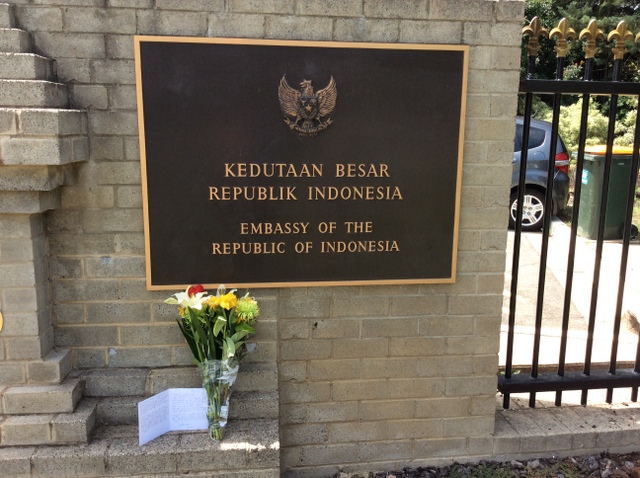
Flowers with card tribute left at Indonesian Embassy
This is the inscription written on a card left with flowers outside the Indonesian Embassy today.
Dear Myunan, Andrew and families
What kind of card do you buy for someone who could be facing the firing squad any day now? What words could possibly bring comfort to you and your families?
To Joko Widodo and any in the Embassy with any influence, Australia and Indonesia are friends. Friends do not do this to one another. There is no shame whatsoever in showing mercy and kindness in this situation. Andrew and Myunan give hope to families affected by drugs that people can change. Sparing them from the firing squad will keep that hope alive.
To Myuran, Andrew and your families, we are praying for you. Your dignity and strength has been nothing but inspirational. I will continue to pray for hope and strength. Please know that many people feel very, very strongly and care very, very deeply about what happens to you and your families.
To Brintha, from one little sister to another, hang in there. You and your families have done absolutely everything you possibly could have done.
With hope
FFDLR February Newsletter 2015
The 2015 February Newsletter is now available here>>
19th Annual Remembrance Ceremony
The Annual Remembrance Ceremony for those who lose their life to illicit drugs will be held om Monday 20th October 2014 at 12:30pm to 1:30pm at Weston Park Yarralumla.
In the past few months something of a miracle has happened.
It happened in April this year in the context of the release of the report by the Australian Crime Commission. The media release from the ACC said this:
"New evidence released today in the Australian Crime Commission's Illicit Drug Data Report 2012–13 reveals seizures and arrests of nearly all drug types across the country were at record highs."
Minister for Justice, Michael Keenan, at Melbourne's Alfred Hospital released the report saying:
"The information released today is as encouraging as it is challenging. Law enforcement is making significant inroads in the fight against illicit drugs. We're detecting more criminals and disrupting more illicit drugs before they hit the streets," Mr Keenan said.
"But there is much more work to be done and this report also provides critical evidence so that decision makers and law enforcement officers can develop further strategies to undermine the business models of organised crime and combat the threat of illicit drugs."
Well, we have heard that or something similar many times before. It is not new. Seizures and arrests are up so we must be making a difference. We haven't won yet but there is much more to do. We are spending $X millions and promise more in this fight.
This years report is accompanied with colourful info graphics to emphasise that the almost 102,000 arrests are the highest on record and that the drug seizure numbers of almost 87,000 are also the highest on record.
While the data may look dramatic and have some marginal use it does not show whether progress is actually being made in this war on drugs. It essentially shows increased drug availability/use and/or increased police activity. It does not show the impact the arrests or seizures might have made on the drug market.
The Australian Bureau of Statistics estimated total consumption of the major drug group in 2010 at 247,092kg and drug seizures according to the ACC amounted to 7,131kg. Therefore drug seizures for 2010 was a miniscule 2.9 percent of that consumed. This is a more realistic measure of progress in this war on drugs. A result that would not trouble any supplier but if publicised by the ACC would be an embarrassment to it and all those promoting the war on drugs.
One could also argue that increased arrests are taking the manufacturers and dealers off the streets and thus are having a significant impact. Well, no. The vast majority of arrests are of users - 81.4 percent in fact, while only 16.8 percent of arrests are of dealers.
But will the arrests of those 83,000 users make a difference? This arrest rate of users is only about 3 percent of the millions of people who use drugs in Australia. How many people need to be arrested to make a real difference? And do we measure the collateral damage and cost of bringing these people in contact with the criminal justice system?
Has there been any realistic comments by anyone of importance since the release of the ACC data. We can discount the Minister for Justice because he is just reading from a prepared speech about which he has little knowledge or understanding.
Well yes there has, and this is the miracle. The Melbourne Herald Sun carried this as a headline: Police chiefs admit drugs they seize are just the tip of the iceberg. In the newspaper article AFP Commissioner Tony Negus admitted “This isn’t a problem law enforcement can arrest its way out of.” This may be the first time a serving member of the AFP has admitted that the current system of trying to stop drugs using the criminal justice system hasn't worked.
Sometimes miracles come in pairs because the same newspaper report also quoted: “It’s not a war we will ever finally win,” Mr Abbott said on 3AW. “The war on drugs is a war you are going to lose."
So having realised and publicly announced this reality will he do something more sensible about it? Well he went on to say: “You may not ever win it, but you’ve always got to fight it.”
Hmmm. I had my hopes up for a little while.
ABC Foreign Correspondent: Cannabis Inc. lacks objectivity
Comment sent to the Australian Broadcasting Commission 18 June 2014
Your story "Cannabis Inc" by Ben Knight does not report many factors relevant to the issue, such as the pre-legalisation situation in respect of cannabis in Colorado (and currently in the rest of the USA), it leaves the impression that no one was using before legalisation and that no one was making money before legalisation. Nor does it refer to the effects of prohibition such as the human and financial costs of being arrested.
To give some examples of content that would have made the report more balanced:
in 2010 2.2 million US citizens 12 years-old and over used cannabis - the report should have made it clear that this many people were already using cannabis,
in 2012 over 650,000 US citizens were arrested for marijuana use - your report should have made it clear that the Colorado portion of these citizens would no longer run the risk of being arrested,
the FBI reported that there is one marijuana arrest every 42 seconds - your report should have indicated the law enforcement savings for Colorado now that they do not have to make so many such arrests,
increased health costs if any, rather than just Patrick Kennedy's view, could have been objectively reported from more knowledgeable sources, and whether or not usage increases in the long run is yet to be determined by factual evidence not opinion,
Patrick Kennedy's comment "This is about a commercial for profit behemoth coming in to prey on your kids, addict them and make money off of them and at your expense" which was left as the last comment, is unanswered. Before Colorado's legalisation cannabis was sold by the behemoth of organised crime and the profits were untaxed and the market was unregulated to all, including 12 year-olds. Disputes were resolved by violence not a court of law. Since legalisation cannabis is regulated to over 21 year-olds (not kids), and the businesses are regulated and taxed. Any disputes can now be dealt with by law rather than violence.
Your next Foreign Correspondent should include the above points by way of explanation that a number of factors were not covered by Ben Knight's story. And perhaps you could produce a second story with a more balanced approach.
[Editor's note: There are of course concerns about unfettered commercialisation of cannabis and the lessons learned from alcohol and tobacco must be taken into account. There are however many models for legalisation and regulation of cannabis and the choice of model needs to be one that causes the least possible harm to individuals and the community.]
World leaders call for change to prohibition laws
Many world leaders have recognised the failure of drug prohibition and are calling for change. The list is growing ever longer by the month.
A list of those leaders by country and their statements can be found here>>>
Abbott Government fails first test on drug policy
The Abbott Government, with no consultation or explanation has recklessly defunded the peak body, the Alcohol and Drugs Council of Australia (ADCA)
"Axing all funding for ADCA without consultation and in pursuit of a false claim of fixing the debt shows up the Federal Government as unprincipled and evidence free", said Brian McConnell, President of Families and Friends for Drug Law Reform. "This peak body provides the best evidence based advice and guidance to all drug and alcohol service providers throughout Australia. It has also provided that advice to past governments. This Government may not like unbiased reliable advice but the service providers have found it to be invaluable for the provision of their services."
"The loss of central coordination that follows this ill-advised cut will be a severe blow to all who are seeking help for their problematic drug use. It will mean that service providers will follow their own random paths and not apply best practice. The end result will be adverse social consequences for their clients and that will cost future governments dearly and will run contrary to the agreed harm minimisation policy of all Australian Governments."
"Financial cuts to this peak body that provides high quality policy advice, resources and guidance will ultimately affect the standard of services provided especially to those who most need the service - the poor, the homeless, the socially marginalised, and the indigenous."
"ADCA was established in 1966 and has been a well-respected by all governments since that time. To defund so swiftly and without explanation is incorrigible", said Brian McConnell. "And Drug Action Week organised throughout Australia by ADCA has provided an excellent week for the AOD sector to publicise its services to the public".
Without this organisation those in the AOD sector will be left floundering for information and support. Mr McConnell urged the federal government to reconsider this poor short-sighted decision.
Open letter to Federal Health Minister about management of synthetic drugs
12th June, 2013
The Hon Tanya Plibersek MP
Minister for Health
PO Box 6022
House of Representatives
Parliament House
CANBERRA ACT 2600
cc Mark Butler MP
Dear Tanya
Management of synthetic drugs - request for National Drug Summit
It is now almost 20 years since, as President of Families and Friends for Drug Law Reform, I have been advocating a change away from prohibition drug policy. Back in 1992, when my son died from a heroin overdose, the injustice of our drug laws became most evident. Many other parents who lost children at that time also were appalled that the drug laws could work so adversely against their family members.
We began to call for change. The heroin on prescription trial almost came to fruition and I understand you were supportive, but unfortunately it was overridden by the then Prime Minister.
Since then governments have continued to avoid discussing or debating any real response to drugs especially those that would make a real and lasting difference to lives and families. Instead it has continued down the road of prohibition which today 20 years later has lead to more and more drugs of unknown quality and strength but with families still bearing the brunt of such poor policy making. I recognise that the harm reduction element of the three pillar harm minimisation policy, which in turn operates under the prohibition umbrella, has made a difference, but that difference has only been at the margins.
We have discussed prohibition policy a number of times with you and other politicians and most, including you, have been supportive of these views and had an understanding of our position.
We appeal to you now, not to continue down this same failed road of prohibition which has lead to the use of synthetic drugs and which is proving to be even more harmful than the ones they replace.
Let's hope we don't experience another conversation as the one the UK's Professor David Nutt had with a politician after his article on a realistic assessment of the risks of ecstasy:
Politician: You can't compare harms from a legal activity with an illegal one. Professor Nutt: Why not? Politician: Because one's illegal. Professor Nutt: Why is it illegal? Politician: Because it's harmful. Professor Nutt: Don't we need to compare harms to determine if it should be illegal? Politician: You can't compare harms from a legal activity with an illegal one.
(Professor Nutt says it is not the only time he's had this circular conversation with an MP. His book is well worth a read: "Drugs - without the hot air: Minimising the harms of legal and illegal drugs".)
Might we even suggest that if the Labor Government was to put up a well thought through scientific, evidence based policy on the way forward for drugs it might even help it to a better outcome at the September election and for families. A simple statement to say that the populous path of prohibition is not the way to deal with synthetics and proposing a National Summit would contribute. It is also worth noting that responses to survey questions that ask about support for legalising and regulating drugs in Australia are usually much greater than 50 percent and global organisations receive tens of thousands of support votes when they call for change.
We at FFDLR certainly do not promote drug use but we know that many young people are going to try them and we want these young people kept alive and as healthy as possible until they grow out of their drug using stage, as the majority will.
The call to the Federal Government by the NSW and Victorian Governments comes in part because of the death of Henry Kwan who, it is reported took a synthetic LSD compound (known on the internet as 25B-NBOME) that he had obtained from a friend who in turn bought it over the internet.
The NSW Government's knee-jerk response targets only retail stores selling synthetics but it does not address the purchase of such drugs over the internet, the source of the drugs from which the young man's drug was purchased. And of course selling drugs over the internet, as has been declared by many an expert in the area, is impossible to control. In effect the NSW Government has removed a measure of regulation and handed that market over to drug dealers. (Media reports say that much of the shelf stock of synthetics has been sold to dealers.)
The Federal Government needs to consider a broad range of issues.
On the question of effectiveness of the current prohibition regime, very few would argue, based on the evidence, that prohibition has worked. It has caused a huge illegal black market in drugs that cannot be stopped at the border. The latest Illicit Drug Report states that over 93,000 illicit drug arrests were made and 23.8 tonnes of illicit drugs were seized in 2011/12. Of the 23 tonnes of drugs seized, that represents only about one tenth of the estimated 238 tonnes of drugs that had been consumed during the year in question. And of the 93,000 arrests some 81 percent of those arrests are of drug users. The cost to society and to governments is not just that most of the 75 percent of the drug law enforcement component of each year's budget is ineffective, but more jails are built, and the courts are clogged with drug users who would be better served by improved access to drug treatment services.
It is all very well to talk tough about these synthetics, as you have done, but a consequence of the prohibition of the current set of drugs is that users or experimenters turn to these synthetics and even prescribed drugs as substitutes. Talking tough will make no difference, and simply banning will do nothing more than drive sales underground to drug dealers. But in any case no amount of banning will stop the sales via the internet - there are over 700 websites in the EU that can supply these drugs. And if the government manages to ban a particular chemical compound, chemists in those countries will simply tweak an existing compound or invent a new one to circumvent the ban.
I urge you to consider the following: we know the relative dangers of the drugs that these synthetics are imitating, and from reports such as those from the Professor David Nutt we know they are less dangerous than is often portrayed. We also know that additional danger comes from the prohibition regime that causes the drugs to be of an unknown strength and purity. Should those drugs be regulated then the strength and purity can be controlled and the product can be appropriately labelled together with safe use messages and warnings, a ban on advertising, limiting sales to adults, and honest education about the harms of excessive use. This would have the effect of minimising the harm and would also reduce the demand for synthetics - if the user's preferred drug is available then there would be less need for alternatives.
All prohibition has done from its beginnings is to move the illegal market from less harmful forms of drugs to more harmful. The drugs become more concentrated to make them more easily smuggled. For example prohibiting opium has resulted in heroin, prohibiting coca has resulted in cocaine and then crack. And now we have synthetic cannabis and other synthetics that mimic other banned drugs.
The following excerpt from the Guardian dated 29 May 2013 tells of the possibilities of a more pragmatic approach (guardian.co.uk/commentisfree/2013/may/29/drug-prohibition-rise-legal-highs).
"There is a solution, but it's just not one likely to be met with much approval from either the prohibitionists or the legalisers. But this is a time for pragmatism. I visited a taxpayer-funded ecstasy pill-testing laboratory in Utrecht this year. Users arrive at the clinic, hand their drugs to a trained professional who tests them for impurities, then gives them back with a calculation of their contents and contaminants – though in the Netherlands there is little to no contamination and hardly any market in legal highs. Staff told me that 99% of all pills in the Netherlands contain MDMA. There are test centres in every major town. The knowledge that a user can have their drugs tested keeps Dutch dealers honest – and the drug supply chain purer than elsewhere in the EU."
There is much research throughout the world where countries are experimenting with new approaches like the one above in the Netherlands. You need to have your Department research the full range of alternatives and their consequences before responding to the requests of the state governments of NSW and Victoria, consider what could be adapted for Australia and start moving towards change.
Perhaps a first step could be to call a National Summit which brings together experts who have knowledge of the alternatives, user groups, family groups and service providers from across the globe. That summit to be rigorously based in evidence and also with the objective of putting life and wellbeing first.
I am aware that you will be under some considerable pressure from the states to take some action but can I urge that you take a considered approach to this issue.
FFDLR would also like to meet and discuss this issue with you before any such action is taken. To this end we will shortly be in touch with your office to make that appointment.
Yours sincerely B McConnell
President
Highest drug seizures and arrests = Costly losing battle
The latest Illicit Drug Report states that over 93,000 illicit drug arrests were made and 23.8 tonnes of illicit drugs were seized in 2011/12 - "the highest reported in the last decade," says John Lawler, Chief Executive Officer of the Australian Crime Commission.
Lawler's forward to the report suggests a losing battle by police throughout Australia. He says: "There have been changes in the availability and use of drugs ... increased availability of drug analogues and novel substances ... changes to drug supply routes and concealment methodologies ... technology continues to empower buyers and extend the reach of sellers" ... but ... "constant is the presence of organised crime. The illicit drug market remains the principle source of profit for organised crime".
In a year of highest arrests and seizures why is this battle being lost? A clue lies in the hidden market/fishing rule: if your favourite fishing spot nets you more fish then you can be sure that there are more fish to be caught. Thus in this year of more users and drug captures, you can be sure that there are more available to be caught. The amount of drugs available on the streets could be as much as 238 tonnes.
The same rule applies to arrests but it is mostly not the dealers that are arrested - most arrests are of users (81.7%).
Unfortunately, no costs associated with the capture of drugs and drug users are included in the report for us to evaluate just how much this losing battle costs. Australian cash-strapped governments should look to this area for cost-saving in balancing their budgets.
Still time to join the Drug Law Reform Australia Party
The Drug Law Reform Party's strategy of making drug law reform an election issue depends on getting 500 members and registering as a political party.
It isgetting close to this goal but needs your help to spread the word.
At the current rate of members joining they will be about 50 short of the AEC requirement.
Here’s what you can do to help.
Get a friend to signup
Get a family member signup
Spread the word by sharing our posts on Facebook and other social media
Forward this email to like minded groups or organisations
Write a letter to the editor about us
There is free supporter membership and $25 full memberships available. Both qualify for the Party to be registered by the Electoral Commission. Link here>> to the Party's website.
You can also view Marion McConnell speaking at the launch of the party here:
Media Release
Recent amphetamine seizure represents one month's use
"The seizure by police of 585 kg of ice, whilst a great effort, only represents an estimated 6.8 percent of Australia's yearly usage1, or in other words one month's consumption", said Brian McConnell, President of Families and Friends for Drug Law Reform.
"While this new report of the 'largest drug bust ever' could lead one to believe the end of the drug trade is near, in reality the report simply camouflages the ineffectiveness of trying to prevent drugs coming into Australia."
Families and Friends for Drug Law Reform has for many years been calling on law enforcement organisations to report their efforts in a more effective way, avoiding the sensationalism, and reporting seizures relative to consumption.
Large seizures usually indicate an increase in importation of the drug.
"The real stories contained in this news are
that the seizure will be but a small blip (if any) in the supply of amphetamines,
that the huge profits to be made from amphetamine sales will simply attract new suppliers to replace those arrested."
"This is a classic case of repeatedly doing the same thing and expecting different results."
"Until the whole concept of prohibition is examined and different approaches are attempted, nothing will change."
For more information: Contact Brian McConnell (02) 6254 2961 or mobile 04 0907 4033
Global Declaration by parents and families for better drug laws
A Declaration for parents, family members and their friends and Family Organisations, who have witnessed and suffered from the existing response to drugs.
A Declaration for Parents, family members and their friends have suffered greatly as a result of the prohibition drug laws and policies.
A Declaration for family members have died or been murdered, been imprisoned, suffered poor health and denied essential treatment services as a direct or indirect result of prohibition drug laws and policies.
A Declaration that will call for governments of each country to re-align their drug laws and policies so that human rights are protected, problematic drug use is treated as a health and not a criminal issue, and a Declaration that also calls on the Secretary-General of the United Nations to evaluate existing treaties and to promote an international drug control regime that causes the least possible harm.
Find out more and how to sign the Declarationhere >>>
Alternatives to Prohibition
Australia21 has released its second report "Alternatives to prohibition- Illicit drugs:how can we stop killing and criminalising young Australians".
This second report on Illicit Drugs was launched by Dr Richard Horton, Editor-in-Chief of the prestigious British medical journal The Lancet, on Sunday 9 September, at the Adelaide Convention Centre, on the eve of the 2012 Population Health Congress. The Report focuses on what Australia can learn from the experiences of three countries (Portugal, Switzerland and the Netherlands) which have liberalised their drug regimes in some way, and one country (Sweden) which has followed a strict law enforcement policy.
The report can be found here >>, and the Australia21 media release can be found here>>.
An edited version of Dr Horton's remarks at the launch was published on the opionion page of the Sydney Morning Herald on Monday 10 September - access it here>>.
Media release by FFDLR:
Australia21 report can save young lives
Families and Friends for Drug Law Reform congratulates and welcomes the second report from
Australia21 entitled "Alternatives to prohibition - Illicit drugs: How we can stop killing and criminalising young Australians".
"Australia21 is one of the few organisations that has had the courage to speak publicly on the
grave consequences that is visited on young people and their families because of our prohibition
drug laws," said Brian McConnell, President of Families and Friends for Drug Law Reform.
"Prohibition has been an experiment that has failed. Even though the United Nations recognised
this in 1988, it and the rest of the world persisted, thinking that if they tried even harder it might
just work. "
In its 1988 convention on drugs the UN, among other things, said that it was "Deeply concerned
also by the steadily increasing inroads into various social groups made by illicit traffic in
narcotic drugs and psychotropic substances, and particularly by the fact that children are used in
many parts of the world as an illicit drug consumers market and for purposes of illicit roduction,
distribution and trade in narcotic drugs and psychotropic substances, which entails a danger of
incalculable gravity."
And yet it continued with the same failed policies with no evaluation and it even believed that it
could achieve a drug free world by 2008.
"Australia21 has examined the prohibition policy and has identified some of the possible options
for consideration. In short Australia21 has thrown the gauntlet down and challenged Australian
governments to discuss the alternatives," said McConnell.
"It is telling that Australia21 has focused on the fact that the drug laws are killing our young
people as this report is released just one day after the 20th anniversary of the overdose death of my oldest son. If the use of drugs had not been driven underground by the prohibition laws and if it had been treated just as a health problem, we would not have been in the dark about his drug use and we might have been able to save his life........"
Read full media release here>>>
It is time to reopen the national debate about drug use, its regulation and control
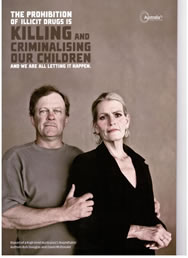
Australia21 has released a report entitled "The prohibition of illicit drugs is killing and criminalising our children and we are all letting it happen".
The report states in clear terms that the present prohibition drug laws have failed and it is time to reopen the debate.
The report was written following a round table discussion attended by health experts, former members of parliament, a former AFP commissioner, a former Director of Prosecution and QC, academics, family members and young people.
Download a copy of the report by clicking the image of the report:
Media Release by FFDLR: Open debate for better drug laws needed High level Australia 21 report supported
Families and Friends for Drug Law Reform strongly supports and endorses the Australia 21 report of its high level roundtable that calls for an open debate on Australia's prohibition drug policy.
....
"Criminal syndicates and corrupt officials, who run this hugely profitable black market trade, are the result of prohibition laws. Governments pour money into law enforcement, yet more than 75 percent of the drugs are consumed undetected. Only small change is given to the more effective health based options. Our young people are easy targets for both the drug trade and law enforcement. Prohibition drug laws do not protect our children," said McConnell.
"Governments and members of parliaments make those prohibition laws and they must be held responsible for the collateral damage that those laws cause", said McConnell. "They must evaluate the laws that they have supported. It is time for governments and members of parliaments to overcome their fear of debating failed drug policies. It is now time to end the procrastination and inaction".
Petition for a public debate about drug laws and policies
On Thursday 17 November Marion McConnell on behalf of FFDLR presented a petition of over 300 signatures to Amanda Bresnan, Greens member for Brindabella, for tabling in the ACT Legislative Assembly.
When handing over the petition she said: "Our prohibition drug laws were never based on evidence or research but rather on false morality, racial prejudice and international pressure.
"It is incumbent on our lawmakers to realise their full responsibility in all the actions they take, or don’t take, and all the possible flow on consequences. Politicians must realise how important their actions are in what happens to families and the whole of society through their decisions on drug policy.
"In all these years since my son died I have not swayed from this conviction that our drug laws are unjust. It is the young and vulnerable who are sacrificed while the multi billion-dollar illegal drug industry continues to flourish.
"The possibilities flowing from it could be quite significant. It could contribute to saving lives, reducing social costs, reducing crime and corruption, and save the ACT budget significant sums of money."
FFDLR's 16th Annual Remembrance Ceremony for 'those who lose their lives to illicit drugs' is now on YouTube here>>>
The Beckley Foundation's Global initiative for Drug Policy Reform which also has a petition addressed to Ban Ki Moon and all Heads of State saying: "We call on you to end the war on drugs and the prohibition regime, and move towards a system based on criminalisation, regulation, public health and education. This 50 year old policy has failed, fuels violent organised crime, devastates lives and is costing billions. It is time for a humane and effective approach."
Review of Portugal's drug decriminalisation
In 2001 Portugal decriminalised all drugs including heroin and cocaine. There were many who predicted adverse outcomes such as rampant drug use, high rates of drug tourism, increased addiction and related illnesses. However some eight years later, none of these predictions have eventuated. Dr Caitlin Hughes presented at a Public Meeting Thurs 17 Nov 2011, 12:30pm
ACT Legislative Assembly. The title of her talk was "What can we learn
from the Portuguese decriminalisation of illicit drugs. Find the PowerPoint presentation here >>> and the news release from the UNSW National Drug & Alcohol Research Centre here >>>.
FFDLR
supports introduction of a needle and syringe program (NSP) in the ACT
prison for the following reasons:
In
spite of intensive efforts to interdict supply illicit drugs are
readily available in the prison
Syringes
currently find their way into the prison and are shared
NSP
programs reduce the spread of blood borne viruses
Health
services available outside the prison should also be available to
those incarcerated
Prisoners
are sent to jail as punishment not for additional punishment
Prisoners
should be released from prison at least as healthy as when they
entered
The
safety and health of prison officers will be improved
Overseas
countries have successfully adopted NSPs in prisons
Read
opinion piece here>>
Read
editorial in August 2011 Newsletter here>>
Read
about international experience here>>
The Public Health Association of Australia was commissioned to say how it could be done.
Read report here>>>
The ACT government asked for submissions on the PHAA report. Read some reports here>>>
Regulating drugs - does it work?
Here is what happened when just one illegal drug was regulated and controlled:
Homelessness reduced to 1%
Unemployment reduced from 73% to 44%
Illicit drug use reduced § Health of individuals improved
Countries that provide heroin as an opiate substitution treatment:
Belgium
Canada
Denmark
Germany
Luxembourg
Netherlands
Spain
Switzerland
UK
Countries that provide morphine and/or codeine as an opiate substitution therapy:
Austria
France
Luxembourg
Switzerland
Alternative World Drug Report
The Alternative World Drug Report, launched to coincide with publication of the UN Office on Drugs and Crime’s 2012 World Drug Report, exposes the failure of governments and the UN to assess the extraordinary costs of pursuing a global war on drugs, and calls for UN member states to meaningfully count these costs and explore all the alternatives.
Early
June 2011 the Global Commission on Drug Policy launched its report on
the international stage saying: "The global war on drugs
has failed, with devastating consequences for individuals and societies
around the world." The
Global Commission Drugs is a 19 person panel comprising many former
presidents and high officials of a wide variety of countries and who
have a great deal of experience of the consequences of their countries'
experience of drug policies.
Click image to obtain a copy Transform's new guide to legal regulation of drugs.

 This is the inscription written on a card left with flowers outside the Indonesian Embassy today.

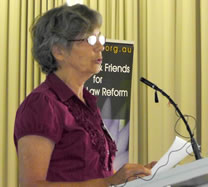 On Thursday 17 November Marion McConnell on behalf of FFDLR presented a petition of over 300 signatures to Amanda Bresnan, Greens member for Brindabella, for tabling in the ACT Legislative Assembly.